




Confusion arises among business owners as rules change
Some local food cart pod owners are struggling with sudden changes to new laws affecting them in Tigard, and are saying it’s unfairly keeping their businesses from growing.
This comes after an emergency ordinance that changed Tigard’s food cart law in January, as well as personnel changes in the City of Tigard economic development staff.
“To expedite reforms to reduce regulatory and cost burden, as well as protect public infrastructure, the city adopted amended food cart regulations through an emergency ordinance,” said Schuyler Warren, assistant director of community development with the City of Tigard.
New Rules

Part of the rub stems from how the city enacted the new law under an emergency ordinance, which means the city bypassed the usual waiting period for introduction and final passage by declaring the matter an urgent need. Some business owners say they didn’t know, and had already spent money setting up shop based on the old rules.
The old rules for food cart pods in Tigard stated that they must meet state definitions for a vehicle or trailer; must meet the Tigard definition for an eating establishment including a city business license and county health license; and must be located on paved surfaces not obstructing anything that would make the area unsafe.
The old rules came into effect on September 5, 2017, but food cart development standards have been in place since 2014. The new rules were adopted January 28, 2025 through emergency ordinance, following a regular April 2024 update as well.
Any food carts that were already in operation and listed themselves on the city of Tigard’s registry before May 31, 2025, were grandfathered into the old rules.
The new rules are more extensive and specific. Some of the contested specifics business owners say are causing problems include that the food cart pod cannot increase its total number of carts after January 31, 2025, and that all food cart pods are located completely on paved surfaces. There’s also a more official food cart approval process now.
Walter “Chip” Barnett is an inspection supervisor with the City of Tigard who testified at a municipal court case on October 28 against George Miller, property owner of Tigard’s Hudson Plaza food carts along Pacific Highway. Barnett said the establishment needed more plumbing and mechanical permits for work being done, in order to get up to code.
“We have municipal codes that are for fire, life, and safety, and are there to make sure that the citizens are protected from any potential hazards,” Barnett said. “We could potentially be poisoning our citizens or ourselves.”
Food Cart Pod Complaints
At the municipal court case on October 28, Miller said NW Natural worked on the gas line at his property, and he assumed it was up to code with the city. He also said he wasn’t aware of the lawful changes that happened abruptly, because he wasn’t specifically notified.
“If we didn’t know (about the new law changes), then how did we know we’re doing something that was not approved and nobody showed us?” Miller said. “We have food carts totally visible from the city highway … it’s reasonable that (we) would be informed.”
Tigard’s municipal court presiding judge is Emily Oberdorfer.
“What I’m hearing is a deep level of frustration about the lack of communication, and that’s not something that I can rule on today,” Oberdorfer said at the hearing. “That may be something that needs to be brought up with city council, and there may need to be legislative changes, that may be something the Land Use Board of Appeals can tackle.”
Ultimately, the judge ruled that the city should waive the non-compliance fees fees for now as long as Miller is working toward coming into compliance.
The order mandates that the property owner and all tenants secure valid City of Tigard business licenses for every operation on the site.
Regarding infrastructure, the respondent faces a 90-day deadline to obtain permits and pass inspections for unpermitted water and gas lines, as well as submit approved plans for grease and wastewater management; otherwise, the unpermitted infrastructure must be removed and specific cart operations ceased.
Furthermore, the owner must file appropriate land use applications for the current food carts and site modifications, or face the alternative of halting development and removing all but two food carts from the property.
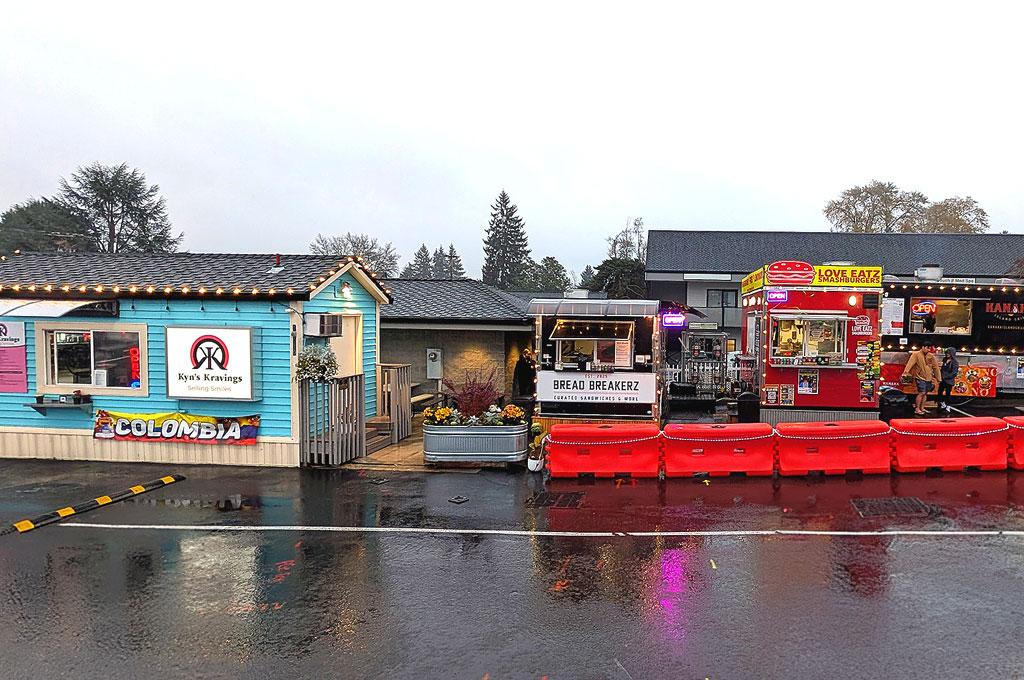
Baller Park Food Cart Pod owner Ky Le started planning his Shady Lane business in September 2023, with three carts opening in early 2024. Previously, Le opened night clubs in Portland, has an architectural degree, and worked as an underwriter for Commercial Bank specializing in strip malls, he said.
“Before I (opened), I started a conversation with Tigard Planning (Department) to confirm what I needed and whether my project complied with their code. I asked what was the application process, permits, and limitations on food carts,” Le said. “I did ask … about the new code changes and they assured me it didn’t apply because I was grandfathered in.”
Le said he lost his savings trying to operate a food cart pod in Portland, which contributed to stress, heart attacks, and emergency operations. He said Tigard’s former staff was understanding, but the staff turnover made it more complicated for his business.
“I had three vendors open, two waiting for a health license, and three more waiting for their food carts we bought to be ready,” Le said. “I can’t tell these people who just quit their jobs and bought expensive food carts that ‘sorry, the city changed their rules.’”
According to Le, the city asked him to reapply for five food cart pods altogether, instead of two additional carts. Then, he said the city issued him two violations, one for electrical permits and one for plumbing, but he says he wasn’t in violation.
“I was always in compliance, they are retroactively applying their … rules that are meant to not only shut existing carts down, but make sure no pods will ever exist,” Le said. “The city did a 180 on me, (and) held me in limbo with the threat of the Tigard three-cart code.”
Le said he does plan to pursue a LUBA complaint, and hopes to reopen next March.
City Response
In an email obtained by Tigard Life from Danelle Hauther, economic development manager with the City of Tigard, to Le in September 2024, she expressed excitement for the success of food cart pod developers.
“I want to acknowledge that you are absolutely in compliance with where the property stands now with three food trucks in operation,” Hauther wrote. “One thing we do need to correct here though, is that the interpretation of ‘being on pavement’ does stand as the entire area of the cart needs to be on a paved surface, not just the tires … with the intention to increase safety — no grass fires under vehicles — and protect the environment in case of any spills or leaks from the vehicle — no soft or pervious surfaces like rocks or gravel.”
She said before opening more than three carts, Le would need to submit an application for a minor modification to the property — and would need to go through a full application process to add any more than those five carts to the property.
Warren said the permit center staff are happy to help anyone confused about the regulations that apply to food cart operations.
“We have worked hard to get the word out about food cart regulations and to provide opportunities for prospective and current operators to learn and ask questions,” Warren said. “We held an open forum last spring to help explain city regulations as well as those that apply from the Washington County Health Department and other agencies.”
Warren pointed out that the regulations are also available online. He said the regulations were updated in 2025 in an effort to modernize them from the 2014 version.
“It quickly became clear that those (old) regulations were in some cases ambiguous and in others applied more burdensome processes to food cart approvals than the city desired,” Warren said. “The city also needed to address issues of fats, oils, and grease in the sanitary sewer system.”
He said for brick-and-mortar restaurants, this regulation is straightforward as part of the building’s plumbing permits, but food carts need a separate process because they are mobile.