





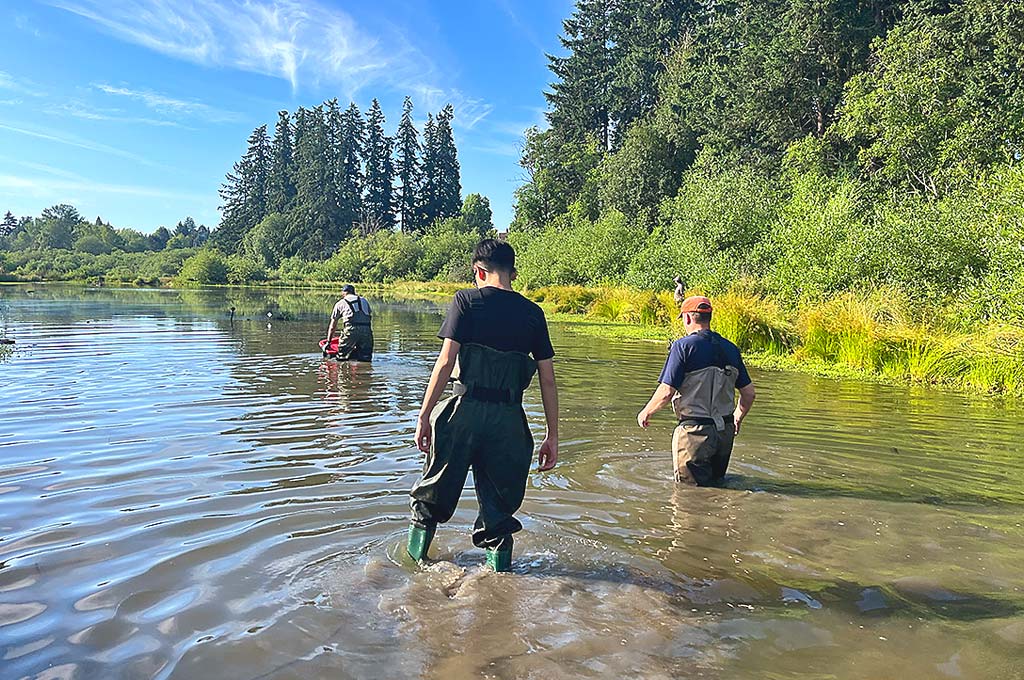
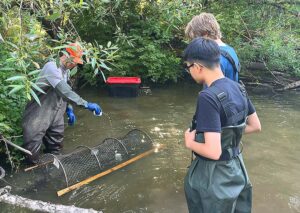
In the early morning on June 24, a small band of Tualatin Soil and Water Conservation District (TSWCD) invasive species staff, a Tualatin River Keeper and some High Schoolers from the Oregon Episcopal School waded out into the murky waters at Summerlake Park, searching for snapping turtles.
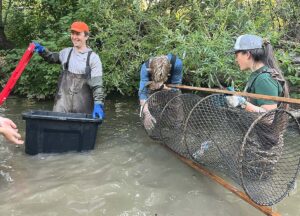
While on the hunt, team members yanked their preset turtle traps up out of the water on the western side of Summer Creek and checked for prisoners. The team checked all seven traps that morning, and the only invasive species caught were fish.
“Last summer, when we did this in July, one day we got seven snappers and three sliders,” TSWCD Invasive Species Coordinator Tyler Pederson told Tigard Life. “Some days, it’s just not the right conditions.”
Since 2022, Tualatin TSWCD team members have been placing half-open sardine cans in net turtle traps, submerging them around Stark Reservoir and Summer Creek, and occasionally luring in invasive species, which they then sent to Oregon FWP for euthanasia. Any native turtles picked up by TSWCD are given a notch and then released back into the creek.
“We had gotten some reports from the public about non-invasive turtles and invasive snapping turtles and red-eared sliders,” Pederson said about TSWCD’s first outing at Summerlake Park. “I think for us it was the fact that this was a known hot-spot for invasive turtles.”
Turtle species native to Oregon, like the Western Painted Turtle and Western Pond Turtle, are endangered by competing species, such as snapping turtles and red-eared sliders. Native species lose out on vital access to food and habitat once invasive turtles are introduced.
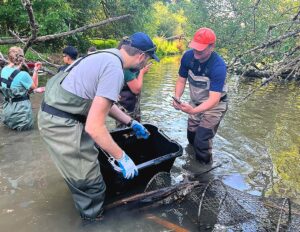
Pederson explained that the TSWCD’s annual trapping excursions at Summerlake are intended to mitigate the destructive impact of invasive turtles.
“We’re, on one hand, trying to think about our native turtles and make it a little bit easier for them and make it so they don’t have to compete so much against these invasive turtles and have more access to habitat and food,” Pederson said. “On the other hand, it was kind of a public safety concern.”
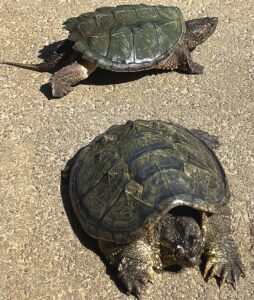
Snapping turtles, in particular, pose a real threat to parkgoers, possessing an incredibly powerful bite. Female snapping turtles can lay up to 75 eggs a year, while Oregon native turtles typically lay only around 10 to 15, said Pederson.
“They are sensitive species,” Pederson said. “When you look at disturbance, whether that’s caused by invasive species or that can be human-caused… ultimately it’s a focus on removing invasive turtles, but it’s also that habitat component, wanting to make sure they have intact habitat they can use.”
A surprising name taking charge of recent efforts to improve native turtle species’ habitat quality in Summerlake Park is local water resource management group Clean Water Services, which, in 2022, helped install multiple “turtle basking pads” at Summerlake Park.
Tigard turtle enthusiast and Education and Outreach Manager with Clean Water Services, Elysia O’Connor, dubbed the months of May through August as turtle basking season, explaining that in the warmer months, turtles spend more time basking in the sun and digging nests.
In 2022, O’Connor collaborated on the construction of basking pads in Summerlake Park, working with students at Cascade Education Corps to research and plan renovations that would benefit turtle populations. O’Connor credited students with the majority of the heavy lifting on the project.
“They read up on what turtles need, and so they designed and built those basking structures and installed them,” O’Connor said.
Cascade Education Corps teacher Michelle Waldram, told Tigard Life that the project was conceived to help native turtles navigate a competitive environment.
“The islands have always had a lot of invasive species,” Waldram said about islands in Summer Creek.
The project, in addition to providing the turtles with more spots to sleep in the sun, also added sand on the island banks to provide more suitable grounds for turtle nesting. Waldram said that during the school year, she and students regularly check back in on and improve nesting areas.
“This year we did a little checking up on the platforms and did some of the work on the nesting beds on the islands,” Waldram said. “I think people are definitely noticing the population out there.”
While the TSWCD went home empty-handed on June 24, they caught two snapping turtles on their expedition the day before and used the less eventful day to demonstrate some of the basics of turtle trapping to OES students, who would be accompanying the TSWCD all week.
Pederson explained that since the SWCD had started trapping at Summerlake, the team would catch around 10 invasive turtles in a week on average, saying that their “biggest week” they’ve “had like 15 or 16.” According to what Pederson had seen while trapping, he said he thought invasive species were on the decline.
“At Summerlake it’s definitely more skewed; the numbers, at least from what we’ve trapped, are skewed towards the invasive turtles,” Pederson said. “The numbers are better.”
Pederson told Tigard Life that on June 25, the team snagged two more snapping turtles as well as two red-eared sliders. They finished the week with four snapping turtles and two red-eared sliders.
The Tualatin SWCD invasive species management staff will continue turtle trapping at Summerlake Park until the end of July. To report an invasive turtle or learn more about their program, visit tualatinswcd.org.