




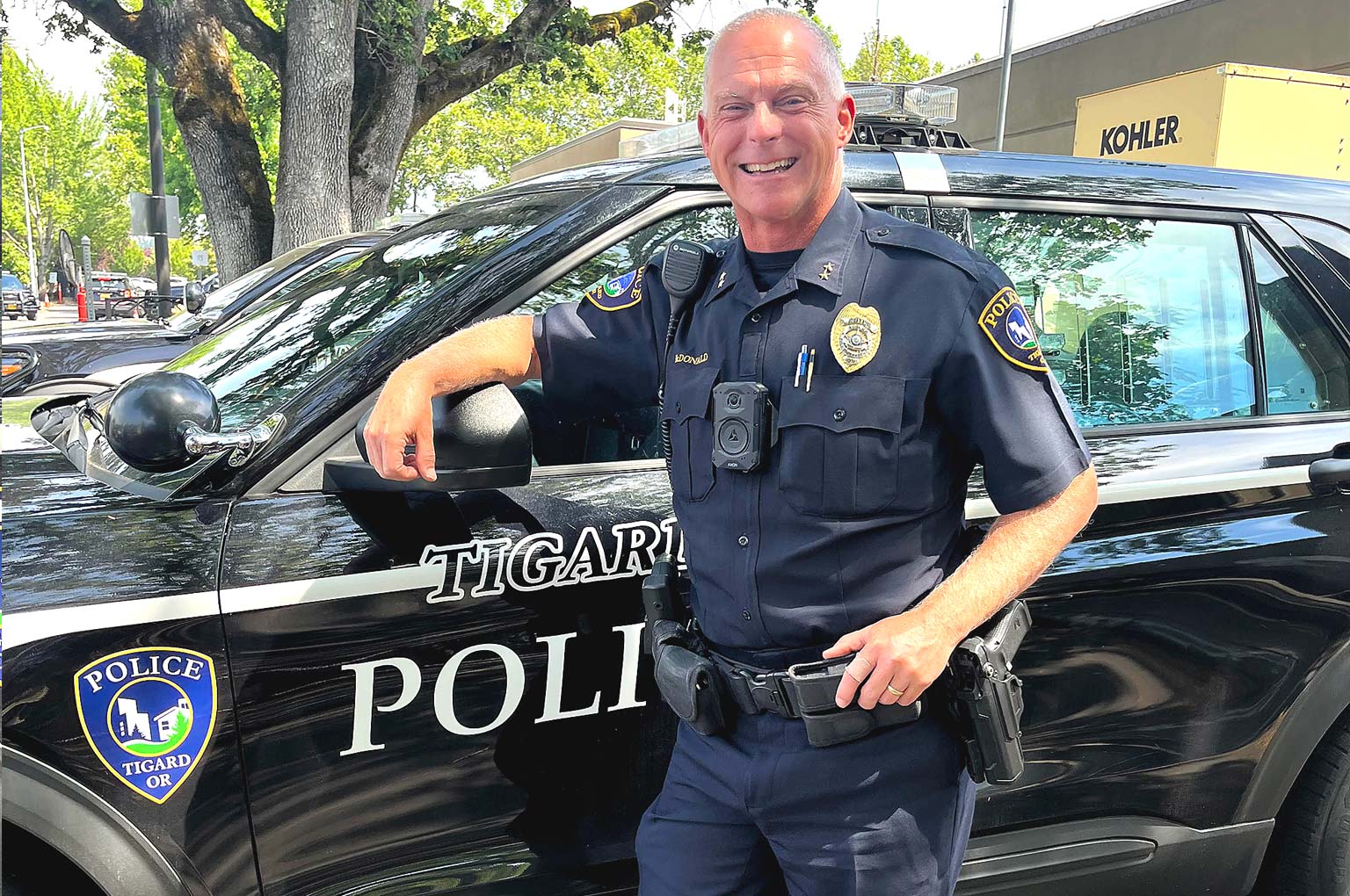
Across a career with the Tigard police force, retiring Chief Jamey McDonald says he’s most proud of the department’s strides in protecting the wellness of officers, including their mental health.
McDonald joined the Tigard force on July 2, 2001, then became the city’s first police officer to climb the ranks to become chief. Twenty-five years to the day later, he’s turning in his badge for retirement.
Commander Robert Rogers, a member of the Tigard force for 29 years, is set to replace McDonald on an interim basis.
Over McDonald’s tenure, the Tigard police force, like many departments nationwide, has done a much better job of recognizing the ill effects of traumatic events on officers’ mental well-being and taking greater care in managing them, McDonald says.
Just under McDonald’s two-year tenure as chief, Tigard police started offering an hour of paid wellness time that officers can take out of their 10-hour shifts to read, walk, meditate, work out or whatever else they need to do to re-ground and recharge themselves, whether mentally or physically.
On average, about half of officers take advantage of two wellness hours a week, McDonald estimates. Wellness time comes in addition to state-mandated breaks.
In the same two-year period, the department distributed wellness apps to help officers do everything from shaking off stress to maintaining good sleep.
When McDonald joined the department, police departments across the country did poorly at managing the impact of trauma on officers, he says. “It was kind of expected, you know, ‘All right, well, let’s get back to work. Let’s, you know, go take the next call.’”
But the sweep-it-under-the-rug response didn’t work, McDonald says. “One of the things I talk about is the average person sees a handful of traumatic incidents in their lifetime,” the outgoing police chief says. “Police officers see hundreds, right?”
But many police departments, including Tigard, are doing better now, McDonald says.
“If we have people that are on a traumatic incident, we have the ability to, you know, kind of unplug them for a little bit and, you know, let them kind of re-center,” he says.
The Tigard Police Department, he says, increasingly appreciates the fact that no two officers or traumas are quite the same.
McDonald cites a hypothetical example of a young officer with small children at home who experiences a traumatic event involving young kids. “That could be a big deal for them,” McDonald says. “It might not impact me in the same way it does them, right?”
“So, recognizing that different people are impacted differently by the exact same event is something that we have to be aware of,” he says. “A lot of it is breaking that old, you know, old-school mindset mentality … of ‘just suck it up and get back to work.’
“It’s like, no, we need to recognize that these events can have an impact on people. I mean police officers are humans, right? And you’re not a … superhero as much as some people would like to think.”
“We’re regular folks with families at home and, you know, providing our staff with the resources that they need in order to be good, well-adjusted people in their personal lives makes them better when they come to work.”
In the wake of his long tenure on the Tigard police force, McDonald says it’s “surreal” to be retiring. It’s a move he planned months ago – and well before voters in May rejected a $150 million bond for new, joint facilities for the city police and public works departments.
McDonald sounds like he takes the defeat in stride, saying voters made it clear they viewed the price tag as too high. Timing also could have been better, he says, considering that gasoline prices of more than $5 a gallon may have shrunk their appetite for new expenses.
With the vote receding in the rear-view mirror, McDonald says he plans to spend much of his retirement dedicated to outdoor pursuits, including hunting elk with a bow, and enjoying more time with his kids and grandkids.
On his first day, he plans to sleep in by half an hour – till 5:30 a.m. – and then head out to refine his skills at river fly-fishing. “I need to get better at it,” he says.