



At their first of multiple meetings on emergency water prep, Tigard’s Water Advisory Board (WAB) advised citizens to be prepared for loss of drinking water.
At their Dec. 10 meeting, WAB discussed what a city-wide water emergency response would entail in the event of an inevitable Cascadia-quake, and/or other disaster scenarios.
Cities across the Pacific Northwest have begun reexamining their disaster preparedness in lieu of the 9.0 magnitude earthquake expected to knock out many municipalities’ functions for “at least two weeks, if not longer,” according to the Oregon Department of Emergency Management.
At WAB’s recent meeting, they said that supplying citizens with a hearty amount of accessible reserve drinking water would be priority one in a multiple-week-long period without essential services, but that citizens should already be somewhat self-sufficient.
“Hopefully you have at least a gallon a day per person for two weeks stored,” Tigard Emergency Services Coordinator Mike Lueck said at the meeting.
Public Works Director Brian Rager spoke at the meeting, saying that the city had been working for years to establish a reliable network of accessible water lines the city could fall back on in the event of a catastrophe.
“We’re talking about trunk lines around the city that we hope to be able to rely on when a bad day happens,” Rager said. “When the bad day happens, we’ll be all over the place…but we’ll be working towards figuring out how the backbone of the system is doing.”
Rager said that while WAB and Public Works “couldn’t say for certain” exactly how addressing a city-wide water failure would look, he emphasized its importance in the eyes of city staff.
Trunk line locations referenced by Rager are not published online and are “confidential” according to Rager because of the essential role they would play in the event of an emergency.
City council member Heather Robbins, who was also at the meeting, said the discussion included many details, but the response initiative was still hard to imagine in detail.
“Lots and lots of details and some of it is even hard to envision because we don’t even know what the disaster is gonna look like,” Robbins said.
In the immediate aftermath of a threat to Tigard’s water resources, Lueck said that Emergency Management would conduct a review of the city’s water system and then form “task forces” and “strike teams” to enter the community and identify compromises in the system.
A task force would be composed of members from Tigard Public Works and WAB, and possibly Washington County Emergency Water Management, according to Lueck.
“We would go out on routes that we have identified already… and roll through the city looking for our critical essential facilities,” Lueck said about the task force.
Lueck said identifying critical damages at essential facilities would be part of the city’s phase one response after an emergency. An additional response protocol would include additional surveys of the damaged area, as well as county and community coordination. Phase two would involve informing the community about the analyses conducted immediately after the emergency and addressing the damage.
“What will it look like for residents trying to get drinking water?” Robbins asked Lueck at the meeting.
Lueck told Robbins, “It may not look too good for the first two weeks,” and advised that community members be prepared for an initial two weeks without power, water and possibly shelter. Two weeks is the interim before the Federal Emergency Management Agency would get directly involved in any kind of large-scale disaster.
Drinking water reserves would be available in the case of an emergency, but exact locations and amounts of available water were kept confidential at the meeting.
“Is anybody ready?” Lueck postured. “Even me, and I’ve got a pretty good thing going on, as far as power and food and all of those things, you’re not prepared for everything…We want everybody to their fullest extent to try and get through for the first two weeks.”
Lueck said that Emergency Management was interested in obtaining additional water treatment equipment for potential disasters, as well as increasing participation among the public and management staff.
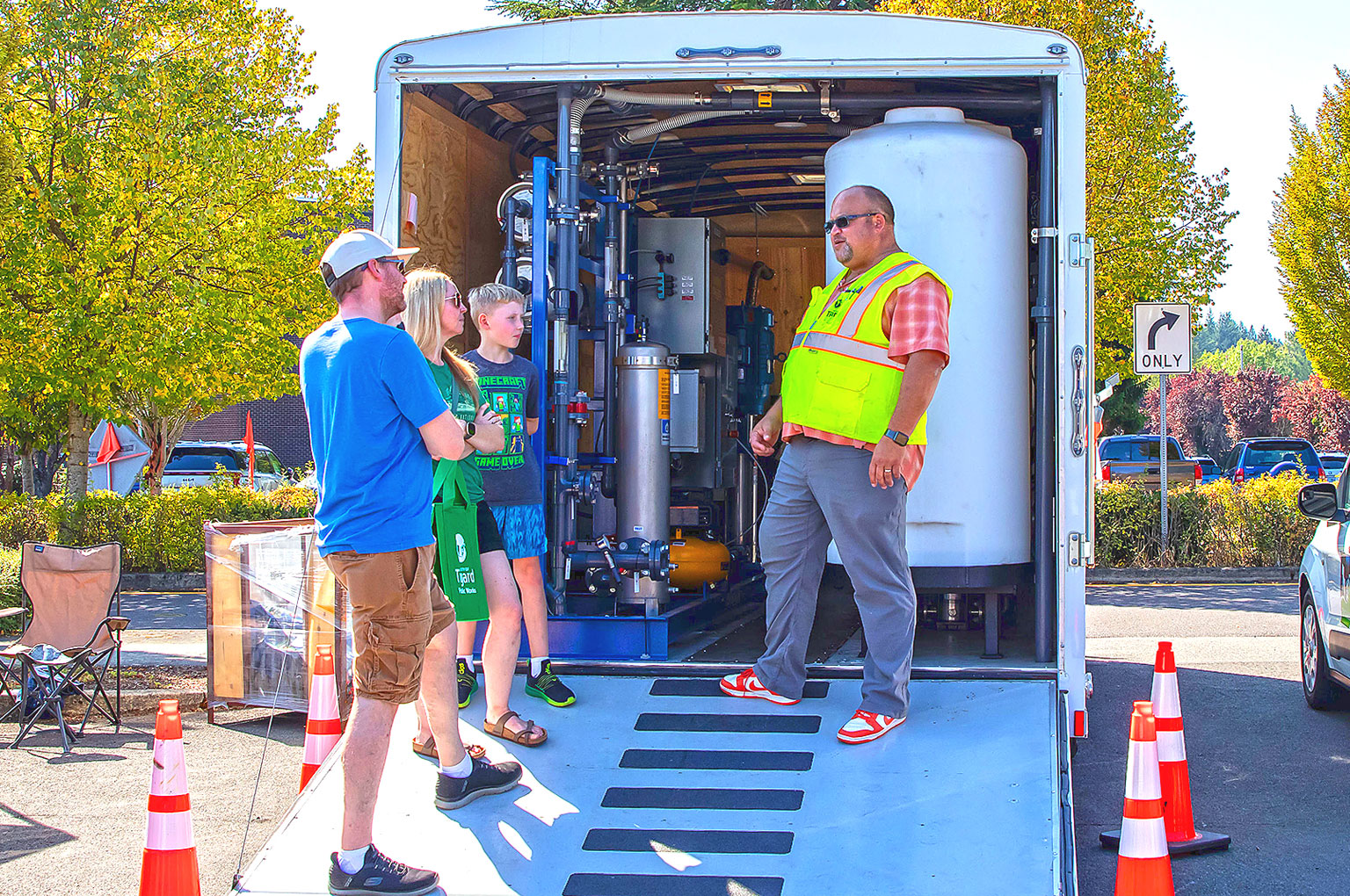
Emergency Water Filtration Trailer
Tigard does not have large-scale water distribution equipment, according to Lueck, but the city did recently acquire an emergency water filtration trailer through a State Preparedness and Incident Response Equipment Grant.
WAB Chair Michael Brewin told Tigard Life that, “This trailer will be the first component in utilizing an alternate water source during an extended water emergency. If the operation of the filtration trailer is deemed satisfactory, then we may be looking at adding another trailer that can be placed elsewhere near a river location.”
The trailer can filter 30 gallons of drinking water per minute, according to Rager, and is not a reliable source for supplying the whole city with water in an emergency scenario.
Even with the availability of the treatment trailer, Rager advised that community members prepare as much as they can so that they’re ready when disaster strikes.
“As much as people can do at home, or amongst their neighbors, that’s gonna be the key in those first days in something like this,” Rager said.
WAB also met with the Tigard City Council to discuss the city’s water management plan at an Oct. 28 City Council meeting, recommending that the city set up an additional city water source, like the Willamette Water Supply Program, and promote water conservation awareness within the community.
“WAB advocates for Tigard City Council to explore options to mitigate water usage and carefully plan for additional water supply options, including accessing the Willamette River through regional partnerships,” WAB Chair Michael Brewin said at the October meeting.
For more information regarding emergency preparedness, visit tigardlife.com/go/emergency.