





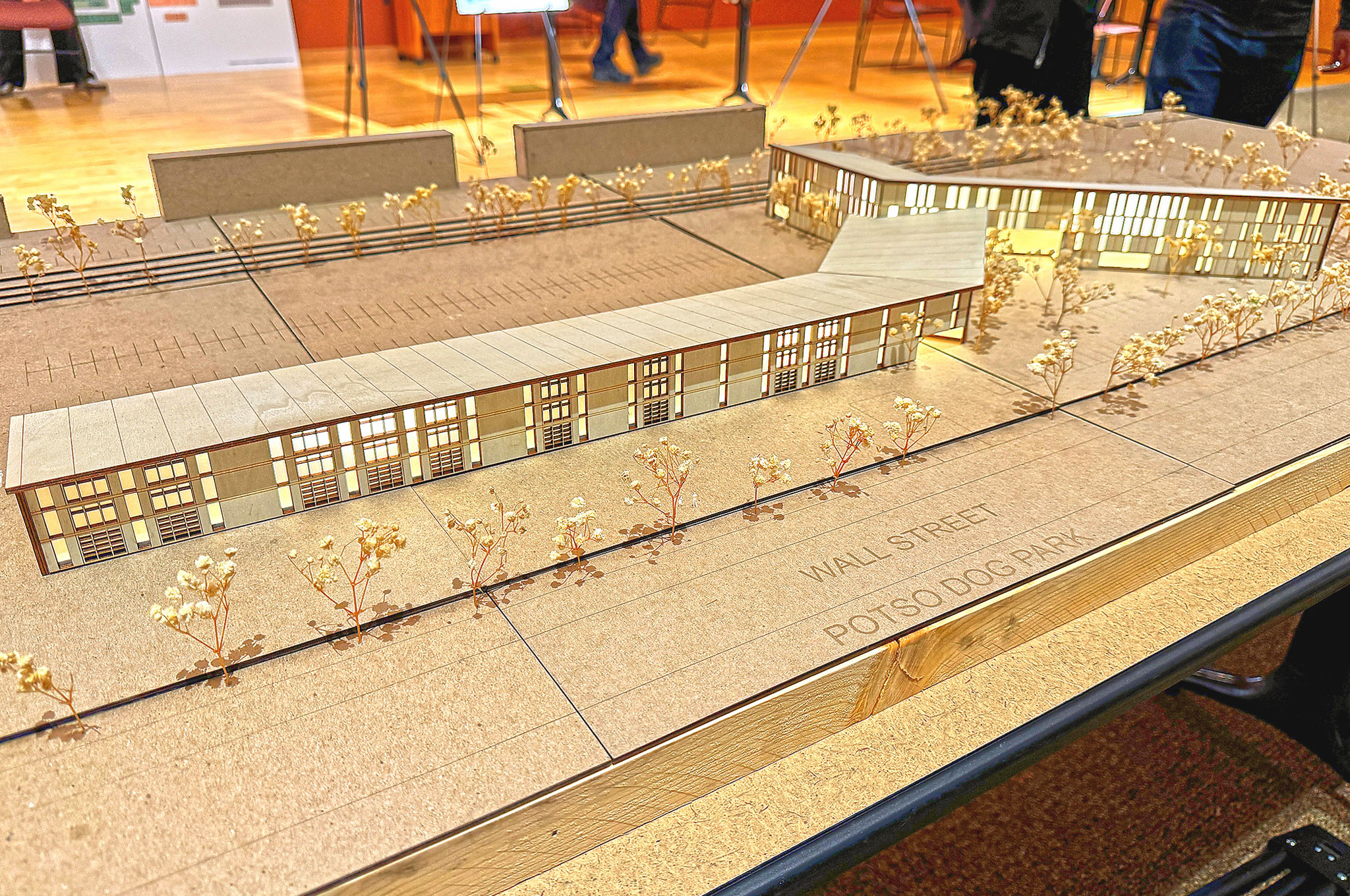
Tigard’s proposed $150 million bond levy to build a joint campus for the city’s police and public works departments has produced a modestly favorable rating among likely May 19 voters, when they are given the most effective messaging, according to the city’s most recent survey on the bond.
At the same time, the 30-year bond also appeared likely to be more expensive – both in reality and perception – since the survey’s results were presented to the Tigard City Council on Feb. 10.
Fielded Feb. 2 to 4 among 400 likely voters, the survey showed 56 percent of participants, given the best-testing messages about the bond, said they favored the project. “That is a significant figure,” Kelsey Anderson, police public information officer, told city council members.
The survey results bear a margin of error of plus or minus 4.9 percent, meaning they predict pro-bond support ranging from 51.1 percent to 60.9 percent. The range is favorable but does not provide a large cushion, especially considering recent bond levy outcomes elsewhere in Oregon.
“You still have a long road to travel, but probably better than in other jurisdictions in Oregon over the past few months,” Ben Patinkin, founder and president of Patinkin Research Strategies, told the council. The Gig Harbor, Wash., research firm conducted the Tigard survey.
A Challenging Climate for Local Levies
Some local levies, particularly those for schools, have failed or barely passed in smaller Oregon jurisdictions over the past year. In November, voters rejected a $172.2 million school facilities bond for Oregon Trail School District, based in Sandy, on a resounding 72 percent “no” vote. Elsewhere, a $1.8 billion construction bond for Portland Public Schools passed with a sound margin in May but with a turnout of fewer than 20 percent of eligible voters.
The rockier road for bond levies is typically attributed to an increase in the fragmentation of digital communications, information burnout, a decline in grass-roots get-out-the-vote operations, and a lower voter appetite for new tax-based financing.
In the case of the Tigard bond, the city’s leadership is aligned behind a strong focus to promote a project it considers the top city priority. Dubbed “Building a Better Tigard,” the goal is to build a more cohesive, spacious, and disaster-protected public safety and service coordination center.
The city has debated various and evolving solutions to cramped quarters for police and public works, which have included several prefabricated office units, for roughly two decades. Meanwhile, the city’s population has grown by more than a quarter.
Identifying the Path to Victory
Survey results suggest voter support is holding stable while opposition is softening. Setting aside messaging, baseline survey readings suggest prospective “yes” voters have fallen 2 percentage points to 41 percent since a similar survey last May, while “no” voters have shrunk 6 percentage points to 35 percent and undecided voters have grown 8 percentage points to 25 percent.
“There is a path to victory, with best-case ballot language starting with a plurality in support and growing to a majority after message treatment,” according to a key presentation slide finding in Patinkin’s summary for city council. “That said, there is a great deal of work to be done with ballot language starting below majority support.”
The results suggest that messages keying on city growth and police response “continue to be incredibly effective,” Patinkin said. The strongest potential gains were found to be among women, politically independent men, and voters without college degrees or living east of Oregon Route 99W.
Rising Interest Rates Increase Taxpayer Impact
But even as the survey results were presented to identify the highest-payoff voter targets, messages and messengers, the price tag of the bond to homeowners had risen.
Immediately following Patinkin’s presentation, City Finance Director Eric Kang detailed how rising bond rates have increased the costs of financing the project since the original taxpayer impact was calculated a year ago.
With property-tax-paid bonds, a homeowner is assessed according to a so-called millage rate – the amount that homeowners pays for each $1,000 of government-assessed property valuation. These values are typically much lower than market value. The average assessed value of a home in Tigard is $344,406, according to the city, whereas the average market value citywide hovers around $600,000.
Over the past year, interest rates on 30-year Treasury bonds have risen. As a result, closely linked 30-year bond rates have gone up, too – in the case of the Tigard bond, about 14 percent.
Previously, an estimated 67-cent millage rate produced a bond cost for the average Tigard homeowner of $230.75 a year, or $19.23 a month. The new estimate puts the millage rate at 76.5 cents, resulting in an average homeowner assessment of $263.47 a year, or $22 a month.
In other words, if the homeowner’s tax for the bond had been assessed on Feb. 10, it would have cost $32.72 a year (or $2.77 a month) more than originally projected.
The actual rate will continue to fluctuate until the Tigard financing is sold on the long-term bond market in August, assuming voters pass the levy. The rate could continue to rise – or it could fall, making the financing cheaper.
Council Opts Against Curtailing the Project
Kang presented a scenario of curtailing the project cost to $130 million to illustrate how the bond tax assessments could be held at its previously projected levels. City staffers speculated that such curtailment might mean eliminating a below-ground floor in which a gun range now is contemplated.
Tigard Police Chief Jamey McDonald cautioned against this. “Reducing the scope could change a lot of the things we’ve been talking about,” he said, noting it would dislocate additions like the gun range and space for evidence storage and training, “which will cramp us moving forward.”
Ultimately, council members put their support behind the original $150 million plan. They stated their desire to build a facility that would meet the needs of Tigard’s police and public works functions for decades into the future, without needing to go back to taxpayers for more money in the interim.
“I don’t want to be the short-sighted council,” said Council President Maureen Wolf.
Moreover, the taxpayer impact remains within the original broad range of estimates that the city had articulated. Mayor Yi-Kang Hu emphasized this point: “Part of being on the council is to look to the future, plan for the future. I do not want to fall short of the city. The direction is strong, so stay the course.”
Voter Pushback and Evolving Messaging
Meanwhile, escalating bond costs and the messaging to voters are fueling pushback. A Feb. 11 update on the Tigard Life Facebook page summarizing the bond survey and costs generated 139 comments, with most readers criticizing the project.
One commenter, Brian Conroy, objected to the use of the expected net gain in property taxes from the bond, rather than its total cost, to highlight taxpayer impact. Both the City of Tigard and a political action committee called Building a Better Tigard have taken the former approach.
The PAC is supported by some key Tigard city leaders who are backing the bond levy, as well as businesses that have been awarded contracts for the project, pending the bond’s approval. Among the PAC’s biggest donors are contract awardees P&C Construction, Perlo Construction, and Scott Edwards Architecture (each with $10,000 in donations), and Otak Inc. ($3,000). The PAC’s fund balance stands at over $60,000.
On their respective websites, the city and PAC both highlighted a figure of $9 a month (for a 30-year bond) that they said the bond would add to the bill of an average homeowner-taxpayer. The city stated the $9 as an “additional” monthly sum, while the PAC said the bond simply “would cost the average homeowner between $9 and $15 a month or between $110 and $180 a year.” (The $15 figure represented the option of a shorter-term bond, which the city set aside.)
This $9-a-month estimate represents the difference between how much an average Tigard homeowner pays now and how much more the taxpayer would be assessed starting next fall. In the meantime, the city is scheduled to pay off a parks bond in June. So, while the two organizations were offering accurate estimates of long-term gains in tax burden, their estimates do not address the total taxpayer impact of the new bond.
As stated above, the best estimates now suggest an average homeowner would pay a total of $22 a month, up from $19.23 as a result of bond-rate increases.
Resident Brian Conroy blasted the net-gain approach in an email to Tigard Life: “That is no different than saying that my wife will be getting a $230 raise this year, so really this bond will cost us nothing!!!”
In reality, it is not uncommon – though sometimes controversial – for taxing jurisdictions to state bond levies in terms of their net effect on taxpayers rather than their total annual or monthly costs. Regardless, the two organizations’ phrasing to define the bond’s average tax burden has evolved.
“If passed, the estimated tax rate for the proposed bond is $0.765 per $1,000 of assessed property value,” the city’s website now states in its FAQ section.
The PAC’s website now says in answer to its own FAQ, “The average homeowner is expected to pay about $13.60 more per month or $163 a year.”
For more details about a proposed bond and project to combine Tigard’s police and public works departments on one campus, go to www.tigard-or.gov/buildingabettertigard
Clarification
In last month’s article, “Tigard Refines Pitch for May $150 Million Bond Measure,” we stated, “The 30-year bond would cost average homeowners about $9 a month extra in property taxes, the city calculated, based on a levy of 67 cents per $1,000 of assessed property valuation.”
While this was technically true at the time of publication (the City has since revised that number to 76.5 cents per $1,000), we failed to highlight the fact that the City formulated the “$9 a month” figure by deducting the cost of the current Parks Bond measure, which will expire later this year.
Without factoring in this expiring tax, the owner of a Tigard home with a $344,406 average assessed valuation would pay 76.5 cents for every $1,000 of assessed value. For the average homeowner, this amounts to a tax assessment of $263.47 per year (or $22 a month).