




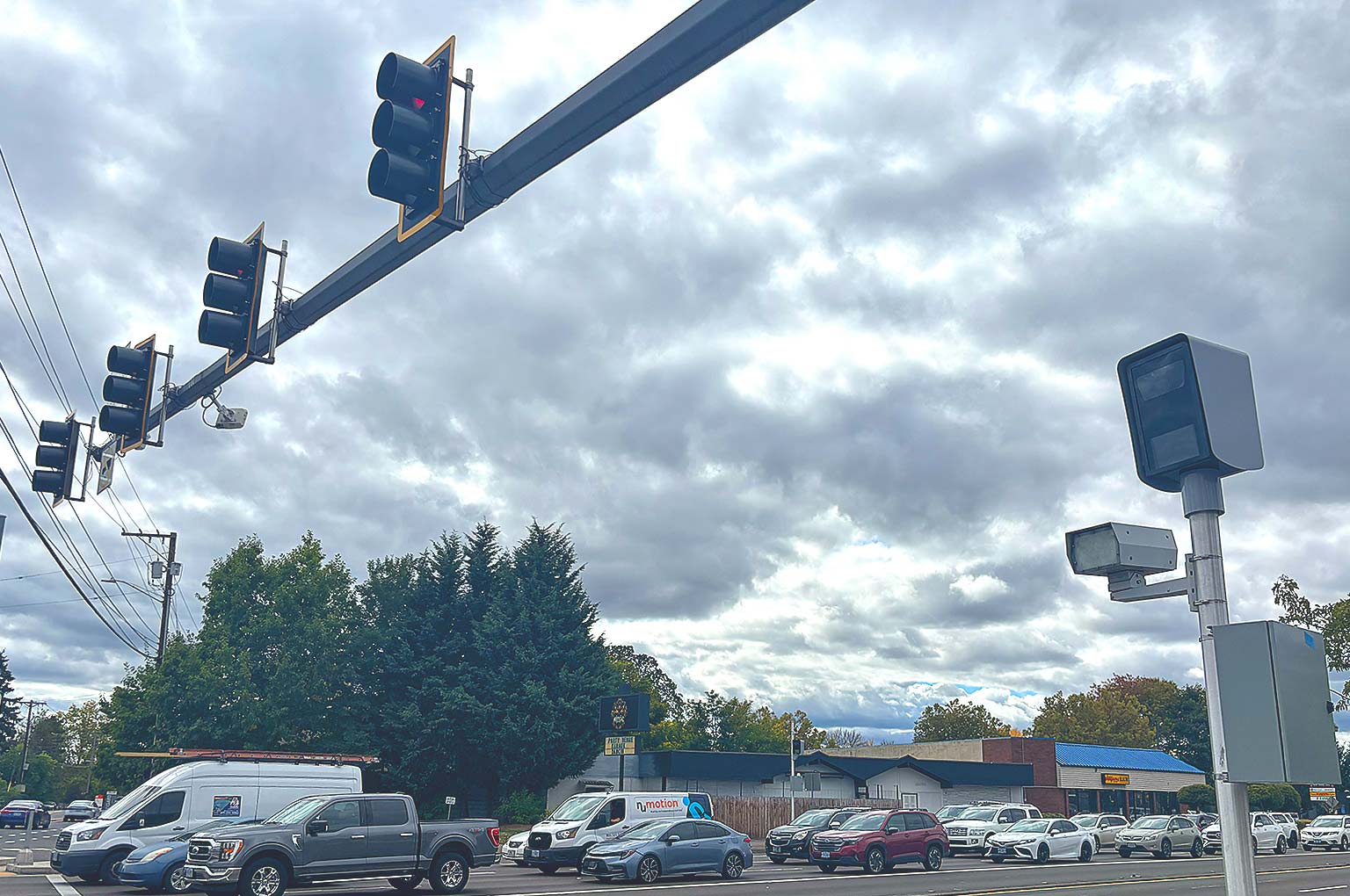
Tigard’s traffic cameras appear to be reducing crashes and identifying violators, while raising concerns about additional work for police and the program’s long-term costs.
At a Tigard City Council work session Sept. 8, officials shared an update on the city’s photo traffic enforcement program, now in its seventh year.
Tigard Police Department Lt. Thomas Clarson said the city has cameras at three busy intersections along Southwest Pacific Highway. At Hall Boulevard, cameras enforce speeding and red lights in all directions; at Pacific Highway and 72nd Avenue, cameras monitor highway traffic only; and at Durham Road, they monitor only red-light violations.
Despite a brief 2025 shutdown for a vendor change, 2026 data show rising citations and fewer crashes compared with previous years. Citations at Durham Road have more than tripled since 2024, while the other two sites also have seen increases.
Total crashes are down 48% since 2020.
“Currently we’re reviewing all citations with sworn police officers, who would otherwise be on the road,” Clarson said. “Their time could be more effectively used responding to calls.”
Currently, the vendor reviews suspected violations and sends video and photos to the Tigard Police Department (TPD), where officers must approve each infraction. Officers also attend trials up to twice a week.
Clarson suggested that council may want to consider hiring three half-time traffic agents to manage the TPD workload “at some point in the future.”
In a separate report, Finance Director Eric Kang said revenues are increasing, but the program has not yet proven to be self-sustaining. Since implementation, it has accumulated a total deficit of $715,000.
After peaking in 2021-22, revenue declined, but fiscal 2026 revenue has improved sharply, up 49%. And while costs ramped up from 2020 to 2024, they have generally leveled off.
Revenue has outpaced expenditures since January, producing a modest $11,000 year-to-date surplus. While still considered a “break-even” proposition, the results are encouraging, Kang said.
“However, at the same time, I would caution against extrapolating six months of performance data to extrapolate the future of the program,” Kang said. “(Staff) will continue to monitor whether this run rate is sustainable.”